

This is part three in a series introducing Riverside County, Missouri—a fictional but carefully crafted community that represents the very real challenges faced by emergency management professionals across America's heartland.
The Numbers That Keep Emergency Managers Awake
Every emergency manager knows these statistics shape everything: population density, poverty rates, age distributions. In Riverside County, it's 78,125 residents across 1,200 square miles. Median age 42.3 years. Poverty rate 18.3%. Behind every number is a family needing protection, a farmstead requiring notification, a life depending on emergency response.
A County Growing Older, Growing Poorer
Riverside County's 3.2% population decline since 2010 tells a familiar story. The median age of 42.3 exceeds the state's 38.8 years. Median household income sits at $48,200—well below Missouri's $55,400. With 18.3% living in poverty versus the state's 12.9%, emergency preparedness becomes a luxury many can't afford.
The county's population—87.4% White, 6.8% Hispanic/Latino, 3.2% African American, 1.4% Native American, 1.2% Other—requires multilingual emergency communications and culturally aware response protocols.
An Economy on the Edge
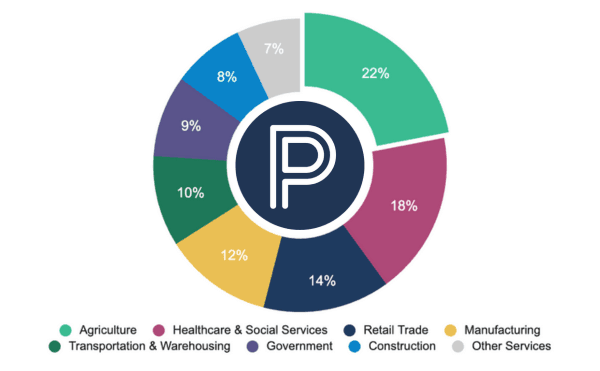
Employment by Sector:
The Big Six Employers:
Riverside Regional Medical Center (890 employees)
American Grain Cooperative (320 employees)
Millbrook School District (285 employees)
Riverside County Government (245 employees)
MidState Distribution Center (180 employees)
Prairie View Manufacturing (165 employees)
These six organizations employ nearly 2,100 people—critical mass in a county where economic concentration creates cascading vulnerabilities.
Infrastructure Lifelines
Power: Missouri Valley Electric Cooperative serves 85% of the county; Ameren Missouri powers Millbrook. Two systems, two sets of vulnerabilities.
Water: 12 public water systems—from large municipal operations to small rural cooperatives—create coordination challenges during emergencies.
Communications: CentralComm provides landline and internet service; three cellular carriers offer "varying coverage"—emergency management code for unreliable rural connectivity.
Healthcare Capacity:
Riverside Regional Medical Center: 400 beds, Level III trauma center, helicopter pad
St. Catherine's Healthcare: 3 nursing homes, 285 total beds
Prairie View Senior Living: 120 assisted living residents
4 rural health clinics
MidState Ambulance: 6 ambulances, 18 paramedics/EMTs
Why These Demographics Mirror Your Reality
Riverside County's human geography reflects challenges facing emergency managers nationwide:
Aging populations with increasing medical needs and decreasing mobility
Economic concentration in a few major employers creating single points of failure
Infrastructure designed for yesterday's population serving today's needs
Healthcare systems stretched thin before disasters strike
Digital divides that make emergency communication a constant challenge
Whether your county has 8,000 residents or 800,000, these demographic patterns shape your emergency response reality. The ratios might differ, but the challenges remain constant.
Test Riverside's Demographic Challenges
With Riverside County preloaded in your free trial, explore how demographics drive emergency planning:
Run these demographic-driven scenarios:
Design a heat wave response for 18.3% of residents living in poverty without air conditioning
Create an evacuation plan accounting for 285 nursing home residents and 120 assisted living residents
Build a pandemic exercise testing one hospital's capacity to serve a four-county region
Generate a winter storm response when six ambulances must cover 1,200 square miles
Ask Preppr demographic-specific questions:
"What emergency communication protocols exist for reaching non-English speaking residents?"
"How does the Emergency Operations Plan address shelter requirements for 405 assisted living and nursing home residents?"
"What mutual aid agreements cover gaps in the six-ambulance EMS system?"
"What are the backup power capabilities for the 12 different water systems?"
Ready to explore?
Sign up for a 14-day free trial to access Riverside County's complete profile and documentation. View the materials, run exercises, and discover how Preppr can transform your emergency management program.
Disclaimer: Riverside County is a fictional jurisdiction created by Preppr.ai for training and exercise purposes. While the county itself is imaginary, the challenges, capabilities, and scenarios are based on extensive research and real-world emergency management experiences.