

Cell 2-1 | Cell 2-2 |
A complete guide to professional document analysis for emergency management
Emergency management professionals spend countless hours reading plans, assessments, and policies. But reading isn't the same as understanding—and understanding isn't the same as knowing what to do about gaps, conflicts, or compliance issues.
Ask Preppr solves this by providing both instant document Q&A and systematic professional analysis tools that emergency managers actually use. Whether you need quick answers from your Emergency Operations Plan or a comprehensive compliance evaluation, the system transforms static documents into actionable intelligence.
Here's what you can do:
General Document Q&A: Instant Answers From Your Documents
What Happens
Upload any emergency management document and ask questions in plain English. Ask Preppr reads your documents and provides specific, professional answers with exact citations.
What You'll Experience
You Upload: Your county's Emergency Operations Plan, THIRA assessment, and mutual aid agreements
You Ask:
"What are the key steps in our emergency response plan?"
Ask Preppr Responds:
"The key steps in your emergency response plan include: Initial Assessment (Section 3.1), Notification of key personnel and partner agencies (Section 3.2), Resource Allocation through the EOC (Section 4.1), Communication with the public through Joint Information Center protocols (Section 5.3), Evacuation Procedures if warranted (Appendix B), Incident Management using ICS structure (Section 2.4), and Recovery coordination with state and federal partners (Section 6.2)."
You Ask:
"Who do we contact for mutual aid during a major incident?"
Ask Preppr Responds:
"According to your mutual aid agreement with surrounding counties (page 12), your primary contacts are: Jefferson County Emergency Management (Director Sarah Johnson, 555-0123), State Emergency Management Division (Regional Coordinator Mike Chen, 555-0456), and the Regional Emergency Response Team (24/7 hotline 555-0789). The agreement specifies that requests should go through your EOC to the State Emergency Operations Center for coordination."
You Ask:
"How many sea shells does Sally have?"
Ask Preppr Responds:
"I'm sorry, I don't have any context in your emergency management documents to answer this. Is there something else about your emergency plans I can help you with?"
Why This Matters
Instead of spending hours searching through hundreds of pages, you get instant answers with exact page references. The system understands emergency management terminology and provides professional-level responses that you can trust and act on.
What's Possible
Instant Research: Get specific answers from multiple documents simultaneously
Professional Context: Responses use appropriate emergency management terminology
Cross-Document Analysis: Ask questions that require information from multiple documents
Context Awareness: The system knows when it can't answer and stays focused on emergency management topics
Specialized Analysis Actions: Professional Document Assessment
Beyond general Q&A, Ask Preppr offers three specialized analysis tools that provide the kind of systematic assessment that emergency management professionals need for compliance, quality assurance, and coordination.
Community Lifeline Gap Analysis
What Happens
This tool conducts a comprehensive evaluation of your Emergency Operations Plan against FEMA's Community Lifeline framework. It systematically examines all eight lifelines (Safety & Security, Food/Hydration/Shelter, Health & Medical, Water Systems, Energy, Communications, Transportation, and Hazardous Materials) to identify gaps and integration opportunities.
What You'll Experience
Document Collection Process: Ask Preppr guides you through uploading the right documents:
Ask Preppr Says:
"To conduct a comprehensive Community Lifeline Gap Analysis, I need you to upload the following documents:
Required Documents:
Emergency Operations Plan (EOP) - Primary plan document
Emergency Support Function (ESF) Annexes - All available ESF annexes
Hazard-Specific Appendices - Plans for specific threats/hazards
Highly Recommended Documents: 4. Mutual Aid Agreements - Regional coordination documents 5. Continuity of Operations Plans (COOP) - Government continuity plans [Additional recommendations...]
Please add your documents from your library now."
You Upload: Your EOP, 5 ESF annexes, hurricane appendix, and COOP plan
Ask Preppr Analyzes: The system conducts systematic self-interrogation, examining every component of each lifeline against your uploaded documents.
You Receive: Comprehensive analysis in professional table format, including:
Component Coverage Matrix: Detailed table showing which lifeline components are covered, partially covered, or missing from your plans
Critical Gaps Summary: Priority table highlighting the most significant missing elements
Integration Assessment: Analysis of how well lifelines connect to each other in your plans
Monitoring Enhancement Recommendations: Specific suggestions for tracking lifeline status during incidents
Implementation Roadmap: Phased approach for addressing identified gaps
Why This Matters
Community Lifelines represent how FEMA now thinks about disaster impacts and recovery. This analysis ensures your plans align with current federal approaches and identifies specific gaps that could leave your community vulnerable.
What's Possible
Complete Framework Coverage: Systematic examination of all 8 lifelines and hundreds of sub-components
Professional Standards: Analysis follows FEMA's official Community Lifeline framework
Actionable Recommendations: Specific, prioritized improvements with implementation timelines
Quality Assurance: Identifies what's working well in addition to gaps
Compliance Support: Helps align local plans with federal expectations
CPG101 Alignment Evaluation
What Happens
This tool evaluates your Emergency Operations Plan against FEMA's Comprehensive Preparedness Guide 101 (CPG101)—the gold standard for emergency plan development. It systematically checks compliance with planning principles, plan structure, essential elements, and integration requirements.
What You'll Experience
Document Collection Process: Ask Preppr Says:
"To conduct a comprehensive CPG101 Compliance Evaluation, I need you to upload the following documents:
Required Documents:
Emergency Operations Plan (EOP) - Basic Plan - Primary plan document
Emergency Support Function (ESF) Annexes - All available ESF annexes
Threat/Hazard-Specific Appendices - Plans for specific threats/hazards
Highly Recommended Documents: 4. Support Annexes - Resource management, communications, etc. [Additional recommendations...]
Ready to add your documents?"
You Upload: Your basic plan, 8 ESF annexes, 3 hazard appendices, and THIRA
Ask Preppr Analyzes: The system evaluates every CPG101 requirement against your documents, checking for compliance with planning principles, structure requirements, essential elements, and integration standards.
You Receive: Professional compliance assessment including:
Compliance Assessment Table: Detailed evaluation of every CPG101 requirement with compliance status and evidence
Priority Recommendations: Ranked improvements needed for full compliance
Integration Analysis: How well different plan elements work together
Implementation Roadmap: Phased approach to achieving full CPG101 compliance
Example Output Excerpt:
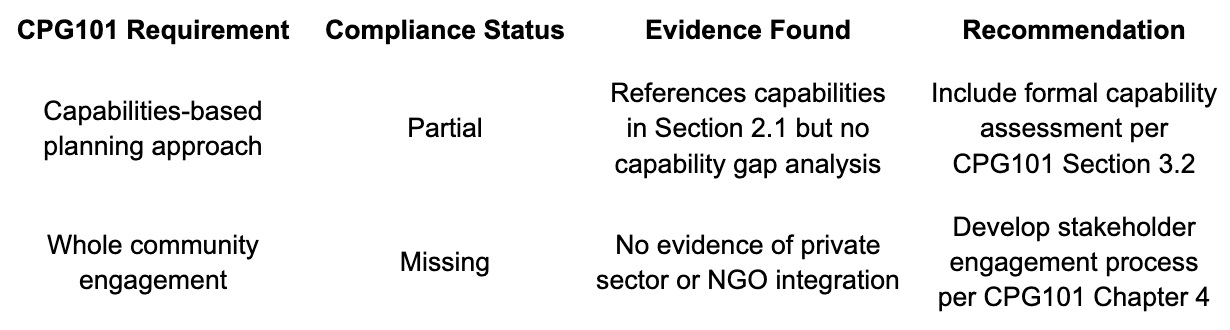
Why This Matters
CPG101 compliance ensures your plan meets federal standards and is eligible for grant funding. More importantly, it ensures your plan actually works—CPG101 requirements are based on lessons learned from real disasters.
What's Possible
Complete Standards Review: Systematic evaluation against all CPG101 requirements
Specific Citations: Every recommendation includes exact CPG101 section references
Compliance Tracking: Clear documentation of what meets standards and what doesn't
Professional Documentation: Output suitable for grant applications and compliance reporting
Improvement Guidance: Specific actions to achieve full compliance
Document Comparison for Discrepancies
What Happens
This tool identifies discrepancies, inconsistencies, and contradictions across related documents. Essential for ensuring partner agencies can actually work together and for quality assurance across plan updates.
What You'll Experience
Document Collection Process: Ask Preppr Says:
"To conduct a comprehensive Document Analysis and Comparison, I need you to upload the documents you want to compare:
For Multi-Agency/Partner Document Analysis:
Upload documents from different organizations or agencies
Include Emergency Operations Plans from multiple jurisdictions
Add partner organization policies, procedures, or protocols
For Version Comparison:
Upload different versions of the same document
Include original and revised versions
Please add your documents from your library now."
You Upload: Your county EOP, the city EOP, state emergency management plan, and hospital emergency plan
Ask Preppr Analyzes: The system systematically compares procedures, authorities, terminology, resource assumptions, and coordination mechanisms across all documents.
You Receive: Comprehensive discrepancy analysis including:
Primary Discrepancy Analysis: Detailed table of every conflict found with exact source citations
Critical Conflicts Summary: Most significant issues that affect coordination
Coordination Gap Analysis: Missing integration points between organizations
Resolution Priority Matrix: Ranked approach to addressing discrepancies
Example Output Excerpt:

Why This Matters
Conflicting plans don't work during real emergencies. This analysis identifies coordination problems before they become life-safety issues, ensuring all partner organizations can actually work together when it matters.
What's Possible
Multi-Document Analysis: Compare unlimited numbers of documents simultaneously
Precise Source Citations: Every discrepancy includes exact page references from all relevant documents
Operational Focus: Emphasizes conflicts that affect real-world coordination
Resolution Guidance: Specific recommendations for fixing identified problems
Quality Assurance: Systematic approach to ensuring plan consistency
Professional Output Standards
What You Get
All Ask Preppr analysis tools provide:
Professional Table Formats: Results in clean, professional tables suitable for briefings and reports
Executive Summaries: Strategic overviews written for senior leadership
Specific Citations: Every finding includes exact page numbers and section references
Actionable Recommendations: Concrete next steps with realistic timelines
Implementation Guidance: Phased approaches to addressing identified issues
Quality Assurance: Built-in verification to ensure comprehensive analysis
What You Won't Get
Ask Preppr maintains professional standards by:
No Speculation: Focuses on reporting what's actually in your documents
No Generic Advice: Recommendations specific to your documents and context
No Assumptions: Clear distinction between what's documented and what's missing
No Overwhelming Detail: Focused on actionable intelligence, not academic analysis
Why Ask Preppr Works
It Reads Like a Professional
The system understands emergency management terminology, frameworks, and standards. It doesn't just search for keywords—it understands context and relationships.
It Maintains Quality Standards
Built-in quality controls ensure analysis is comprehensive, accurate, and professionally formatted. Every output meets the standards expected in emergency management.
It Saves Massive Time
What would take weeks of manual review happens in minutes, with comprehensive documentation that supports decision-making and compliance requirements.
It Scales to Any Size
Whether you're analyzing a single policy or comparing plans across multiple states, the same systematic approach ensures nothing gets missed.
It Provides Actionable Intelligence
Every analysis concludes with specific, prioritized recommendations that you can actually implement, complete with timelines and resource requirements.
The Bottom Line
Emergency management documents aren't just paperwork—they're the foundation of community safety. Ask Preppr transforms these documents from static files into dynamic intelligence that drives better decisions, ensures compliance, and identifies problems before they become disasters.
Whether you need a quick answer about mutual aid contacts or a comprehensive gap analysis for federal grant compliance, Ask Preppr provides the professional-grade analysis that emergency management demands.
Ready to unlock the intelligence in your documents? Ask Preppr turns your emergency plans into actionable insights that make your community safer.